Follow the rules, that’s what we’ve always been told. But I’m here to tell you after 30 years of gaming, sometimes it’s beneficial to not follow them. Sometimes, it’s better to tweak the rules or even make up your own. While there are a plethora of board and miniature games out there to play, not all of them are perfect, in fact it’s hard to find a game that is. Over the years, I’ve often found myself asking, Why did they do that? What part of the game is that rule supposed to balance? Or even just saying, This part makes zero sense compared to everything else.
Change the rules. Have more fun.
Enter the House Rule. I’ve been using house rules as long as I can remember. Striving always to improve my gaming experience with my friends, tossing out mechanics we hated or tweaking things until everyone is having fun. One great example is how we play Castle Panic with The Wizard’s Tower expansion by Fireside Games. In the standard rules, you replace one of your core tower’s with a Wizard’s Tower allowing the group access to powerful spells to fight back the hordes of beasties and bosses. We found that with the new expansion it was far easier to lose towers and if the wizard tower gets annihilated by a flaming boulder those spells are gone, but you still have to fight all of the overpowered beasts in the expansion without them. We continually lost when that one special tower went down early in the game. No one was having fun, so we changed the game up.
Even our favorite games sometimes need tweaking.
We started placing the Wizard tower in the very
center of the six standard towers, making it the last to get hit by enemies
getting into the castle but still allowing it to be set on fire. This one small change made all the
difference. We started winning again,
not every game of course, getting the Chimera and the Dragon breathing fire
every round can still be a game killer with bad token pulls. But we were back to a more standard win/loss
pattern that had us having fun and working hard to hit those card combos and
keep the castle alive.
That’s the point of house rules, get everyone
sitting around the table having as much fun as possible, build those
memories. If something just isn’t
working, change it
House Rules aren’t just for board games.
For miniature games like Warhammer: Age of Sigmar or Star Wars: Legion House Rules become even more important. These types of games can be complex and often time, new players can’t remember a rule, experienced players aren’t able to reference it quickly enough in the rule book, or players interpret rules differently and have a dispute, etc. This is when House Rules truly shine. All players can decide on a solution in the moment, flip a coin, or agree to answer the question later. Following the exact rules becomes secondary to moving on and enjoying the game. (Sorry rule lawyers.) This serves several very important functions. It keeps the game moving, keeps it exciting, makes sure everyone is having fun and helps teach you to not sweat or get bogged down in the small stuff.
All of these things make for much more engaging and relaxed gaming sessions with your family or friends. House Rules can be applied to any game you play. Those rules were written with the best intention of the game designer to provide players with a specific experience. Not all games that make it to market have been play tested to find every possible flaw, and not all games that make it to market are balanced well. Monopoly is a classic example of poor game balance (most games in our experience end in rage or boredom). One player quickly outpaces the rest and everyone else slowly loses the ability or interest in playing the game.
Make your own house rules.
You can go forth and make your games your own! If something isn’t working in a game you’re playing, tweak the rules until the game flows smoothly again. Whatever rule is giving you trouble, change it, rearrange it, or just plan chuck that game rule out. No alarms or game police will arrive if you don’t play the game exactly as the rules are written. If you can alter one thing about a game that has stopped your family or friends from having fun, fix it and let the good times roll.
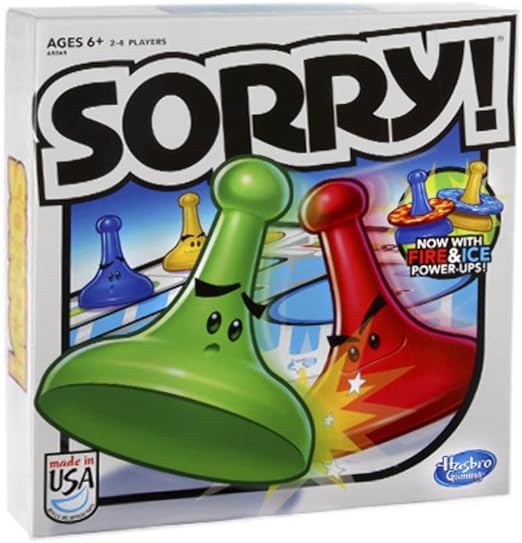
Don’t forget to say Sorry! when you read this review!
I love playing Sorry! with Mom and Dad. It makes me laugh so much. I like booping other people and making them go back to their start. I like swapping my pawns with other players on the board to get closer to home.
I don’t like it when I get booped though!
This game is rated ages 6 and up. I agree it’s a good game for kids, and parents should play it with their kids! If you want to play Sorry! with your kids, you can find it on Amazon Here.
Want more? Check out some of our other lists and reviews below.
We play a lot of games together. But which board games are the most fun? How many of them are easy to learn? And are there any games that are simple enough to get Grandma to play? If you’re looking for our favorite recommendations, this is a great place to start.
Ticket To Ride
Days of Wonder has knocked this title out of the park. Ticket to Ride is one of our very favorite games to play with friends and family. You are a railroad baron, trying to buy up all the train routes on the map. There’s a reason this is one of the most popular specialty board games of all time. It’s fun, fast, and full of opportunity for strategy and treachery.
Ticket To Ride is loaded with pieces, cards, and a massive board that can seem intimidating to new players. But don’t let the hundreds of rail cars and ticket deck fool you. It only takes a couple rounds of play to realize how blissfully simple and exciting Ticket to Ride is. At our gatherings, Ticket to Ride is a family favorite with teens and adults, with a ring of children helping to guide the trains along. We even picked up Ticket to Ride First Journey for young players to enjoy!
If you have a young player who is learning not to be a sore loser, or you’re playing board games with ultra-competitive frat boys stuck in “beast mode”, Castle Panic is the game to play. It isn’t about players beating other players. It’s all of you playing together against the game!
Caste Panic has a rarely seen co-op game style that lends itself well as a party game. You win, or lose, together as you battle monsters that want to destroy your castle. Things get a bit more complicated and difficult if you choose to add expansions (we recommend adding the Wizard’s Tower), but because it’s a cooperative game, setting up house rules to re-balance the game is easy.
Because this game is set up to play as a team, we ignore the age recommendation by Fireside Games of 10 year old and up. The entire game is about coaching your fellow players, so kids who can read basic words like “Knight” and “Archer” can identify their cards and see where they can attack the bad guys. With help, a 6 year old can manage the game just fine. Get your copy of Castle Panic from Amazon Here.
Smash Up
This is not your grandmother’s card game. Smash Up is incredibly fun, and as soon as you start playing this deck building game, you’ll want to play again and again so that you can mix and match factions to see which combinations you like best. Adding to the replay value are the many expansion packs available to increase the wacky options. The base pack comes with slotted storage for additional expansion decks, so this is one game where you don’t have to figure out where to store all the extras – they fit perfectly in the base box.
Although AEG recommends this game for ages 13 and up due to content (because bear zombies are scary?), we play with fantasy loving kids as young as 7 years old. The rules are simple and straightforward, and the artwork is amazing! The cards are as interesting to look at as they are to play, and it’s a game that will keep you coming back for more. Find Smash Up from Amazon Here.
Small World
If you like the idea of conquering a map, but don’t want to play a five-hour game ofRisk, thenSmall World is a great tabletop game to play. A constantly changing game with high replay value, Small World pits different races and powers against one another in a fight to own the board. A fun game that brings together characters like you’d find inMunchkin with world domination like you’re familiar with in Risk.
Days of Wonder recommends the game for players 8 years old and up, and we agree with that assessment because of longer gameplay (around an hour), and a need to be able to understand more complex rules. But if you have younger players who want to try it out, try pairing them up with an older player for team play. Find Small World on Amazon Here.
Tsuro
“You are a dragon, flying through the air…” and your goal is to not fall off the board. This is one of the easiest board games to learn, and virtually anyone can play. Like traveling up rungs and down slides in Chutes and Ladders, your dragon follows a path from one side of the board to… somewhere else. But it’s infinitely more fun and takes more strategy than a simple child’s board game.
Tsuro is a great way to introduce nervous friends and family to tabletop gaming. It’s fast, fun, and great for all ages. The manufacturer, Calliope, recommends Tsuro for players 8 and up, but kids who know how to trace a line can play and we’ve enjoyed it with kids as young as 4 years old. Get your copy of Tsuro on Amazon Here.
Carcassone Classic (With River)
If you have a smaller playing group, want a quick game, and have some clear table space,Carcassone with River Expansion is the way to go. It doesn’t matter where we are, we can always find gamers who are ready to play Carcassone, and for good reason. It’s easy to learn once you get going, and because you build the board is built as a tile laying game, the replay value is high on this title from Z-Man Games. If you ever do want more from the game, there are several additional expansions available, altering the rules and adding to the gameplay for endless fun.
The game is recommended for players 13 years old and up, although many game owners say children as young as 8 can generally handle the rules okay. Find Carcassone on Amazon Here.
Zombie Dice
We’re not even sure how many sets of Steve Jackson’sZombie Dice we’ve purchased over the years. But it seems like no matter where we go, or what we’re doing, we happen to have a copy of the game packed away in our lunch-sack, back of our car, and in our camping gear.Zombie Dice is our go-to dice game to combat boredom. We’ve played it absolutely everywhere, from inside retail stores, to the back seat of moving vehicles, and under tables in convention halls. The rules are simple, straightforward, and easily understood by small children and grandparents alike.
If you’re a fantasy or horror friendly family, then you can feel free to disregard the age rating of 10 and up, which is only because of the topic of zombies (and getting shot with shotguns). But they’re dice, and our son started playing with us as a 5 year old. If your players are able to count up to 3 shotguns and up to 13 brains, then this dice game will be fun and easy. There is virtually no limit to the number of people you can play Zombie Dice with, and the more people who are involved, the more fun it is. Get Zombie Dice on Amazon Here.
Qwirkle
I don’t think we’ve met a player yet who hasn’t enjoyedQwirkle. This shape and color matching game is easy to learn, and tactical strategy quickly comes into play as points begin to rack up. Although Quirkle is highly recommended by MindWare for kids 6 and up, our whole family began playing when our son was a 3 year old (and he was able to win, with a little coaching). Anyone who can match colors and shapes can play Qwirkle! Easily as much fun asScrabble andUno, but with no need to know how to read or identify numbers. Find Qwirkle on Amazon Here.
Munchkin
We’re suckers for Steve Jackson Games, and Munchkinis no exception to the excellent tabletop game experience we’ve come to expect from his studio. Designed for more advanced players (Dungeons and Dragonsbeard-men, we’re looking at you), Munchkin is a deck building game of loot and monsters.
On first glance, Munchkin’s instructions can seem daunting, but if you stick with it a few rounds, you get the hang of the game play and find yourself looking forward to the next hand. We recommend introducing new players to the card game gently, perhaps by playing on teams until the newbs get the hang of the rules. Team-play is absolutely needed if you’re playing with kids younger than 10, as the game cards get cumbersome to handle for small hands, and the card rules may need to be explained to little ones (although they’ll find humor in them and delight in playing). Find Munchkin on Amazon Here.
Sushi Go!
This is one of our favorite card games to play with people who are nervous about playing tabletop games. With colorful Kawaii-style artwork, simple rules and a fast pace that make games quick and exciting, Sushi Go! is everything you want in a simple, fun party game. Suitable for 2 to 5 players (although we’ve played it with as many as 6), and a great game for kids and adults alike. This game is rated for ages 8 and up, but our 6 year old can manage just fine with a few reminders about the rules. Find Sushi Go! on Amazon Here.
Want more? Check out some of our other lists and reviews below.




 Reviews from a family of gaming geeks.